Sleeve
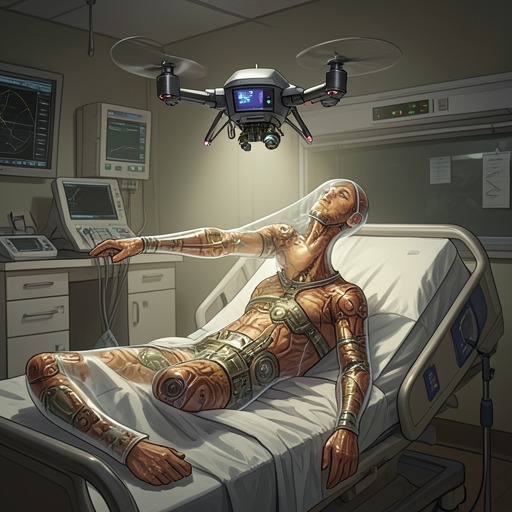
Tinea and Leah: [Cyberpunk, Alien Incursions, Murder and Mayhem, Girl's Love (WLW)]Sleeve is a temporary body-covering used to protect and preserve the wearer during bodily transformation and recovery. In Leah’s case, it becomes more than a piece of equipment: because it mediates modesty, movement, sensation, and the experience of having lost her original limbs, it makes the body’s status as both lived self and replaceable technology impossible to ignore.
Definition and Practical Function
Sleeve operates as a layer of bodily protection rather than a fully convincing replacement body. Its importance is clearest when Leah is recovering from the loss of her limbs. The covering protects her while leaving her dependent on assistance and on unfamiliar artificial structures. Its design can absorb sudden spikes of kinetic energy, but it is not suited to resisting the slow pressure of excessive mass. That distinction means the Sleeve offers real protection without making Leah invulnerable: weaker Antithesis models pose limited danger, while a Five or Six can still seriously injure her by crushing or suffocating her.
The same technical limits appear in the contrast with stronger Antithesis models. A Nine’s blades could cut through Leah’s armor, though not sever her bones, while models One through Four cannot seriously harm her except at exposed sensory points such as the nose, eyes, and ears. The Sleeve therefore belongs to a layered defensive system rather than serving as a magical guarantee of safety. Its value depends on the kind of force it encounters, the protection worn over or around it, and the wearer’s caution.
Leah’s Recovery and the Problem of Fit
Leah’s relationship with the Sleeve is defined by awkwardness. When she first tries to stand, the covering remains on her body while its arms and legs flop loosely from her torso. It resembles a strange tube with dangling parts more than ordinary clothing or meaningful support, and its immediate role is partly to preserve her modesty. The image is comic on the surface, but it also records a severe disruption: the apparatus marks the gap between Leah’s torso and the limbs she expects to possess.
That gap begins to close through practice rather than instant restoration. With help, Leah rises and stands stably, then concentrates on each foot in turn, taking experimental sideways steps before releasing her support and walking in small circles. The Sleeve is thus involved in a process of relearning. It does not simply return mobility to Leah; it becomes part of the scene in which mobility must be tested, observed, and made familiar again.
The device’s clumsiness also makes Leah’s vulnerability visible to Tinea. Tinea watches while Leah learns to use her long new legs, and the covering becomes a conspicuous intermediary between the injured person and the body she is trying to inhabit. Its awkwardness is not merely a defect in manufacture. It gives physical form to the transitional condition of a person whose body is being rebuilt but whose sense of self has not yet caught up with the reconstruction.
Sensation, Prosthesis, and Estrangement
Leah explicitly distinguishes between functional artificial limbs and limbs that feel like part of her. She describes the replacement material as good enough for practical purposes but still “ersatz,” and she wants replacements that feel proper. The central problem is not only whether the prosthetics work; it is whether their feedback allows her to recognize herself through them. The false sensation repeatedly interrupts her absorption in thought, returning her to the shock of feeling like a stranger in her own skin.
Sleeve therefore sits within a larger sensory problem. It protects the body, but protection does not equal embodiment. A body can be safe enough to move through danger while still feeling alien to its owner. The device’s material success and experiential failure coexist: Leah can stand, walk, and eventually adapt, yet adaptation remains different from the restoration of bodily familiarity.
This tension complicates a simple medical idea that bodily difference should be repaired until it disappears. Leah’s desire for better prosthetics is concrete and legitimate, but the narrative does not reduce her experience to a technical shopping list. The relevant question is how equipment participates in dignity, self-recognition, balance, movement, and ordinary comfort. Sleeve exposes the social and psychological cost of an environment in which survival technology may arrive before a body can be made to feel like home.
Gendered Transformation and the Human Limit
Sleeve also belongs to the transformation through which the narrator comes to inhabit a female body. The possibility of becoming a girl overturns a belief that had structured the narrator’s life: wanting that body had seemed impossible, so happiness had been built around accepting that it would never be available. Once the possibility appears, the old arrangement collapses, and the narrator accepts the transformation despite uncertainty about its consequences.
After the chrysalis, the transformed body is experienced through specific physical changes: the limbs are slender, the muscles tight and lean rather than masculine, and the narrator feels graceful. A tail has become stronger and is connected to an elongation of the human spine, while the altered proportions may make it as long as, or longer than, the body. These details show that transformation is not an abstract change of identity. It is learned through weight, balance, movement, texture, and the startling redistribution of attention across the body.
Against that transformation, Leah’s artificial body produces a different kind of estrangement. One body is newly desired but unfamiliar; the other is necessary but experienced as counterfeit. Sleeve helps place these conditions in the same material frame. Both show that the body is not a fixed biological given, yet they do not produce the same emotional result. Desired transformation can become a source of celebration, while imposed replacement can preserve life and mobility without immediately restoring selfhood.
Narrative Significance
Sleeve’s recurring significance lies in its refusal to remain transparent equipment. In ordinary use, a garment or protective shell disappears behind the person wearing it. Here, damage, altered proportions, loose limbs, and artificial feedback make the object visible as an active mediator. It changes how Leah stands, how she moves, how she is seen, and how she recognizes herself.
The object also concentrates the book’s larger contradiction about Vanguard power. Stronger bodies are safer and more capable, but the movement toward greater power entails becoming less human because the human body cannot meet the demands of combat. Sleeve occupies the uncomfortable middle ground between the vulnerable human body and the increasingly nonhuman body required for survival. It is a reminder that technological protection can preserve a person while simultaneously announcing how much of the person’s ordinary bodily experience has been displaced.
For that reason, Sleeve is neither simply a costume nor merely a plot device. It is a transitional object in the fullest sense: a practical shield, a sign of injury, a temporary substitute for bodily continuity, and a visible record of adaptation. Its awkwardness gives material shape to the book’s central question of whether enhanced survival can remain compatible with feeling at home in one’s own body.